Beyond compliance: Safety, health, and social responsibility redefined in the ESG era

Beyond Compliance: Safety, Health, and Social Responsibility Redefined in the ESG Era
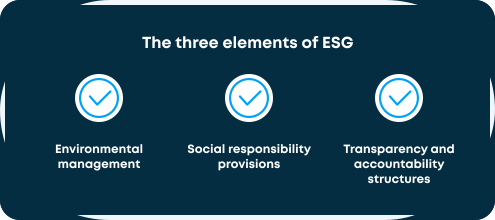
ESG, short for environmental, social and governance, is a term that started in the world of corporate investment but has spread far beyond it, to act as a new shorthand for businesses’ actions to manage their impacts beyond simply generating profits for shareholders.It has superseded sustainability in many areas as the term to describe the drive to manage businesses with accountability to the rest of the world and to use resources in a way that does not disadvantage current and future generations.
ESG is the latest iteration of a principle that goes back centuries, that businesses owe duties to their employees and to wider society. From the 1970s this was formerly known as corporate social responsibility. As understanding grew of the scale of human impacts on the natural environment this social concern was overlaid by calls for organizations to minimize pollution and more recently to manage down their carbon emissions.But if the social element has been initially overshadowed by environmental concerns in expectations of sustainability reporting, there has been a parallel increase in requirements for business to meet minimum standards of care for employees through regulation. Revisions and additions to safety and health law in jurisdictions including the EU and US in the late 20th and early 21st centuries have created frameworks for protection from work hazards, taking in everything from work at height to chemicals exposure.

Now, the social indicators, included in ESG requirements from investors and the fund managers they employ, are pushing safety and health further up the corporate agenda. To maintain investor confidence and high levels of investment, corporations are expected to demonstrate their commitment to protecting workers and maximizing productivity through their own investment in the best available safety technology and techniques.

.webp)

.png)