AI’s role in promoting a proactive safety culture

Safety culture and Artificial Intelligence
Since the 1990s, organisations have attempted to improve safety culture. They have tried top-down approaches, with senior management making statements about how important safety is. They have tried bottom-up hearts and minds programmes, encouraging workers to work safely, and stop if a job can’t be done safely. There have been great strides, and examples of success, such as the UK 2012 Olympic development.However, many safety culture programmes stall after some initial improvements. Senior managers have invested in the programme. Workers on the frontline want to be safer and healthier. Sometimes the obstacles come from the middle managers and supervisors, who are invested in existing ways of doing things. For a busy manager there just isn’t time to get ahead with improvement programmes while they are doing the day-to-day supervision and management tasks.AI might provide some solutions to this stalling pattern, providing the extra set of hands – and eyes – that will help managers and supervisors to get on top of the workload and spend more time developing a proactive safety culture.
What is Artificial Intelligence
General AI is the stuff of movies, generally embodied in a robot or android. Think C3PO in Star Wars, Data in Star Trek, or Ava in Ex Machina. It can respond to questions on any topic. General AI, however, does not yet exist, and some experts claim it never will.Narrow AI, however, is already with us. While traditional software achieves defined goals by following steps prescribed by a programmer, narrow AI can find new ways to achieve goals.This paper focuses on one particular form of narrow AI – computer vision (CV). CV systems learn from libraries of images, and from their experience of interpreting images, how to recognise and track objects. CV is not just programmed to recognise a limited number of objects, but can learn and develop over time. Combined with AI-driven analytics engines, the information from CV can provide accurate predictions and recommendations. CV systems are already in use to screen mammograms, detecting cancers that doctors might miss. Manufacturing systems use CV to speed up and improve the accuracy of quality checks on components and products. You might even have CV on your mobile phone, as it is increasingly being used to provide security through face recognition.Now, there is the opportunity to use CV to improve the safety culture in workplaces, increase opportunities for learning, and reduce serious injuries and deaths at work.
What is Safety Culture
In the 1980s, the term “safety culture” was used to explain how customs and undocumented practices caused the multiple failures that led to the disaster at the Chernobyl nuclear reactor, and later on the Piper Alpha offshore platform.ISO 45001 doesn’t refer to a ‘safety culture’ but rather a ‘culture that supports an organization’s OH&S management system”. Heavily influenced by the UK HSE definition of safety culture, ISO 45001 defines this culture as:
the product of individual and group values, attitudes, managerial practices, perceptions, competencies and patterns of activities that determine the commitment to, and the style and proficiency of, its OH&S management system.
Note: In ISO 45001 the expression “OH&S” means “occupational health and safety” and refers to the protection of physical and mental health, as well as protection from accidents.
A more colloquial description of safety culture is “the way we do things around here when no one is watching.” The over-confident driver sticks to the speed limits when there are cameras – and speeds when there are not. So, is changing the culture about getting everyone to see that something is dangerous, and that the precautions defined should be applied, even when no one is watching? That might be the solution for some measures (such as speeding), but workplaces are more complicated than that. Sometimes the rules might not be obvious, or they might be wrong. What then is a ‘good’ safety culture?

What is 'Good' Safety Culture
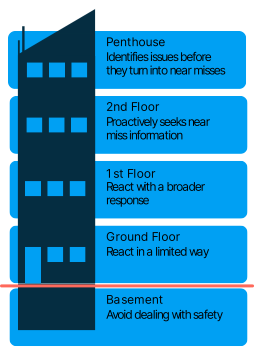
One way of ranking safety cultures is to look at the approach to safety performance taken by the organisation. Imagine it as a building.
Organisations in the basement take no responsibility, even when an accident occurs. They might hide the accident or blame someone else. Sam receives an injury falling off a ladder. Sam is told to take some annual leave until they recover, and no one asks why the accident happened. If you’re reading this paper, it’s unlikely your organisation is at this level.
A lot of organisations are on the ground floor – they react when there is an accident. They look at the immediate cause of Sam’s accident – the ladder slipped, so let’s tell everyone to be more careful using ladders.
The first floor is still mostly reactive, but when there is an accident wider causes are looked for. Did Sam’s ladder slip because its feet were damaged? Or because the ground was uneven or wet? Or because it was being used in a hurry because of poor work planning?
If you’re on the second floor, you’ll already know that it’s not enough to respond when an accident happens. If you’re at this level you’ll be asking the ladder users like Sam to inspect ladders and report damage, or to report problems with unsuitable work sites. You might call these “near-misses” or “hazard reports.” It’s great that your proactive – but you can be even better.Waiting for people to report near misses and hazardous situations is still being reactive.
If you want to be in the penthouse suite of safety culture you need to be PROACTIVE looking for hazards, and pre-cursors of hazards, before anyone else reports them. You do this, not to punish or admonish, but to learn and make changes before any harm occurs. In a topflight safety culture the EHS manager will keep track of ladder inspection training received and inspections carried out. If these metrics drop, you can take action to prevent a problem in the future with Sam’s ladder.
How Do You Promote A Proactive and Learning Safety Culture?
So how do you climb the stairs between safety culture levels? And can you get the lift from ground floor to the penthouse suite? The next few sections highlight some areas for action if you want to promote a proactive and learning safety culture.
1. Reporting
In defining a culture which supports OH&S, ISO 45001 indicates that good reporting is an essential ingredient in becoming a learning organisation:
An important way top management demonstrates leadership is by encouraging workers to report incidents, hazards, risks and opportunities
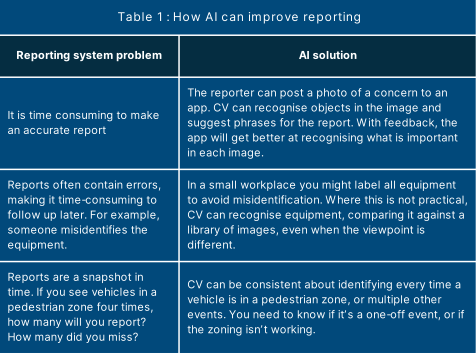
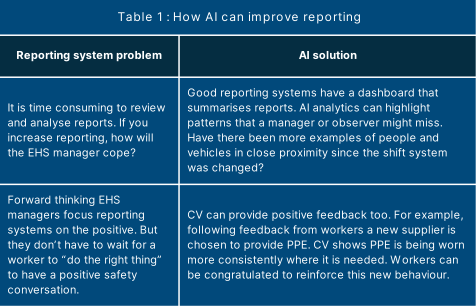
Reporting systems are not new, but they can be cumbersome, and without appropriate feedback, they are not effective. Table 1 shows some of the problems organisations experience with reporting systems – and some examples of how AI could overcome them.
2. Mutual trust
ISO 45001 is clear about the importance of both leadership and worker participation. It emphasises trust in this relationship:
A culture that supports an organisation’s OH&S management system… is characterized by, but not limited to, active participation of workers, cooperation and communications founded on mutual trust.
ISO 45001 clarifies that one key to the trust relationship is that when workers report incidents or hazards they are protected from reprisals, such as the threat of dismissal or disciplinary action. Anonymous reporting might overcome fear of reprisals, but it removes the opportunity to get more detail, and can send a message that there is something shameful about reporting.
Often the disincentives to report are more subtle than disciplinary action. When someone reports that they made a mistake, even the raised eyebrows of a supervisor can be discouraging. Those receiving reports need to believe in a learning culture – that every report is an opportunity to learn and should be welcomed as such.
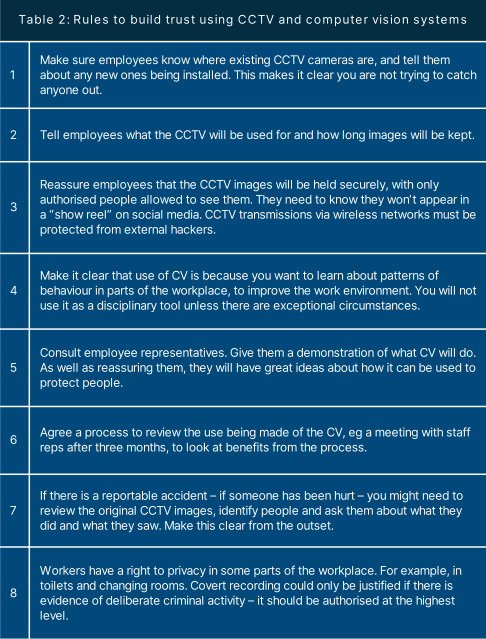
Proposing the use of CCTV cameras with CV might seem counter-intuitive if we want to build trust in a work environment. CCTV on its own, when used carelessly to ‘police’ behaviour will reduce trust. Table 2 provides guidance on how to use CCTV with CV in a way that builds mutual trust in an organisation.
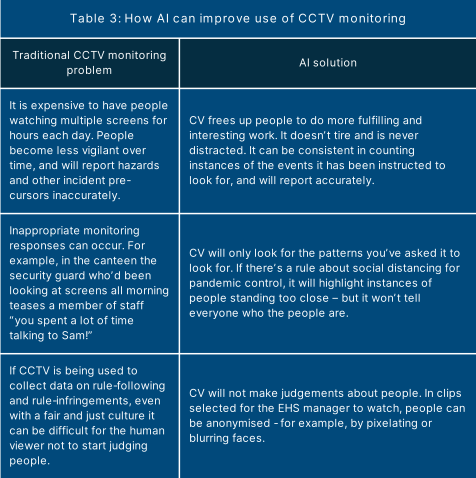
If there is already a trust relationship in your organisation, workers will know that CCTV is in place for their own security and safety – for example, to detect intruders, or to spot if a lone worker becomes unwell. Table 3 outlines some of the barriers than can arise in using CCTV more effectively to create a proactive learning culture – and how these barriers can be tackled.
3.Active Participation Of Workers
Another aspect of the positive safety culture emphasised in ISO 45001 relates to the participation of workers in identifying not just hazards, but opportunities for improvement. ISO 45001 explains that the culture is characterised by:
… active participation of workers … shared perceptions of the importance of the OH&S management system by active involvement in detection of OH&S opportunities and confidence in the effectiveness of preventive and protective measures.
EHS professionals often argue about whether near misses are a proactive (leading) or reactive (lagging) indicator of a safety system. The answer is that it depends on what your report, and what you do with the reports:
- If you treat a near miss or hazard report as an event that you must react to with punishment, new rules or re-written procedures, you are treating it as a lagging indicator.
- If you have identified some of the pre-cursors to accidents (such as people walking in vehicle zones) and record these as a means of identifying what needs to be improved in the safety management system, you are treating it as a proactive (leading) indicator.
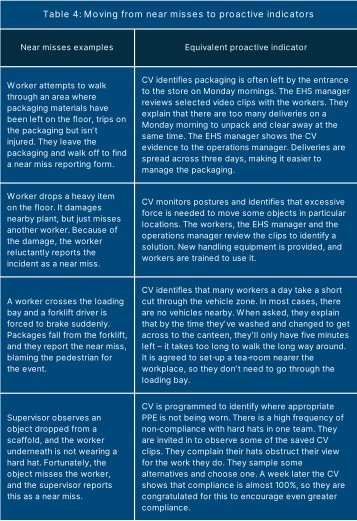
But if we’re suggesting CV to support reporting, won’t that move us away from active participation of workers? CV will allow more time for EHS managers and the workers to work together on identifying the OH&S opportunities highlighted in the quote from ISO 45001. It will give them time to talk. Table 4 gives some suggestions of how this would work.
Conclusion
Using computer vision with CCTV should not result in a “big brother” workplace, where people are disciplined because the computer says they broke a rule.
EHS and operations managers can engage the workforce with problem-solving to identify the environmental factors that lead to unsafe behaviours. The quality of automatic and worker-based reporting can be improved, with the results growing a culture that values learning alongside operational and safety improvements.
.webp)
.jpeg)
