Getting Senior Buy-In for your AI Safety Software Project

You’ve done your research. You’ve read papers, watched webinars, listened to other EHS (environment, health and safety) professionals who are already using AI. You are convinced that it will make a real impact on health and safety in your organisation. But how do you convince senior management to back your AI-powered EHS improvement project?This paper walks you through the steps to follow to persuade senior management that they should invest money, time and resources in adopting AI as part of your EHS management process.
Step 1 Understand which behaviours matter
Step 2 Choose the right solution
Step 3 Learn about your audience
Step 4 Tailor your message
Step 5 Communicate your success
What is Artificial Intelligence
A conventional robot – whether in automotive manufacturing, or the Lego Mindstorms toy – does not use AI. It can be programmed to respond in specific ways to particular cues.
For example, to stop or go when it “sees” a light, to avoid obstacles in its path, or to lift an object. But none of this is AI – the only intelligence is that of the programmer who decides how the robot will respond to defined cues.
We describe technology as intelligent when it can do something that wasn’t specifically programmed. This is narrow AI, because it can only do this within the world the AI expects to experience. A chess programme plays chess, not Scrabble. A virtual assistant such as Siri or Alexa can play a new music track, but can’t compose music.
Step 1: Understand which behaviours and situations matter
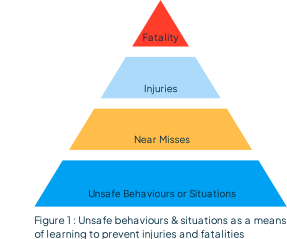
Most EHS professionals will be familiar with the accident triangle. The numbers vary, but the point the triangle makes is that if you only learn from fatalities, you will have few opportunities to improve. You have a few more opportunities to learn from reported accidents, but many organisations encourage workers to report near misses, to improve the chance of learning before an accident occurs. However, near miss reporting systems are often poorly used – people complain about how long it takes to complete a report and the time needed for follow-up. Some workers express a fear of reporting – they might be seen by colleagues as “telling tales” and by managers as a trouble-maker.
An accident investigation will identify situations (such as a leak of oil on the floor) and behaviours (such as walking through a vehicle area) that ‘caused’ the accident. However, these events are rarely unique. The same behaviours and situations identified in an accident investigation have usually happened many times before, but the combination of circumstances meant that an accident was avoided. Someone took a short cut every week through the loading bay. A driver often reversed without a banksman. For weeks, these events took place at different times. But one week the events coincide, and a pedestrian is hit by the vehicle.
Imagine you could be everywhere in your workplace, and could spot every behaviour or situation that could contribute to an accident? You could find out why these events were occurring, and change the working environment to remove them. The accident would be prevented. You can’t be everywhere, but AI provides some excellent tools to help you do this.
The triangle in Figure 1 is a useful way to illustrate this to a senior manager. The bottom of the triangle shows that you have more opportunities to prevent accidents if you can identify unsafe behaviours and situations.
Step 2: Choose the right solution
If you’re not sure about your solution, it will be hard to convince management. There are so many options, what’s the best solution for your organisation at this stage of their development? If your safety management system is based on Excel and Word documents, it might be better to use your resources to bring that up to date first. If you’re struggling to meet legal requirements to manage hazardous substances, a database that provides safety data sheets and supports substance assessments might your first port of call.
What if your risk assessments are up-to-date and your compliance boxes are all ticked, but you are still getting accidents or worrying near misses? Many senior managers see AI technology for EHS teams as at best, a “nice to have” and at worst, an expensive gimmick. They often seem happy to approve an AI tool for HR to filter candidates during the recruitment process, but AI for EHS?
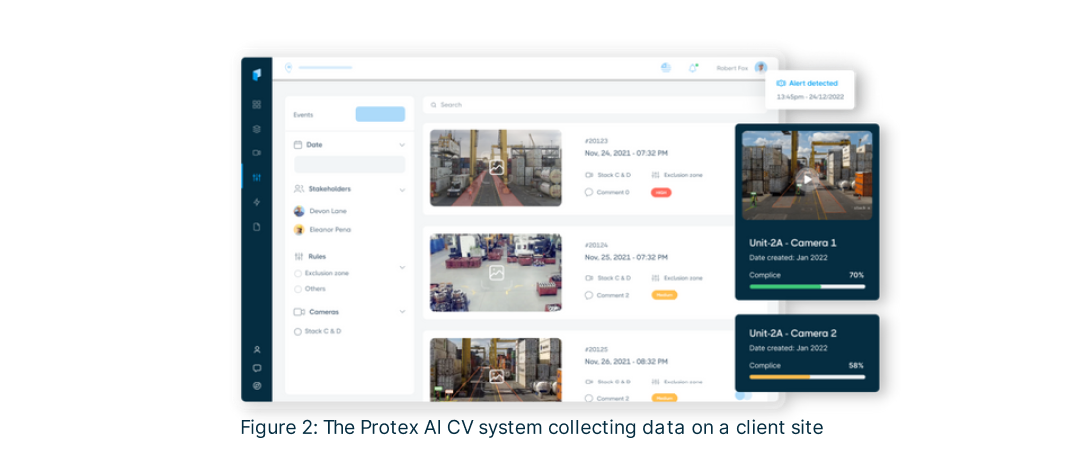
To overturn these attitudes you need to show senior managers that AI isn’t as expensive as they might think. It isn’t about employing androids in high-vis to do a safety manager’s job. It could be a piece of software that monitors your regulator’s website to spot changes in legislation or guidance, using machine learning to support contractor selection, or using speech recognition to support maintenance staff to access manuals in situations where they need their hands to use tools. Or, as we’re focusing on hazardous behaviours and situations that could result in an accident, it could be a computer vision system than plugs into your existing CCTV cameras to detect these events.
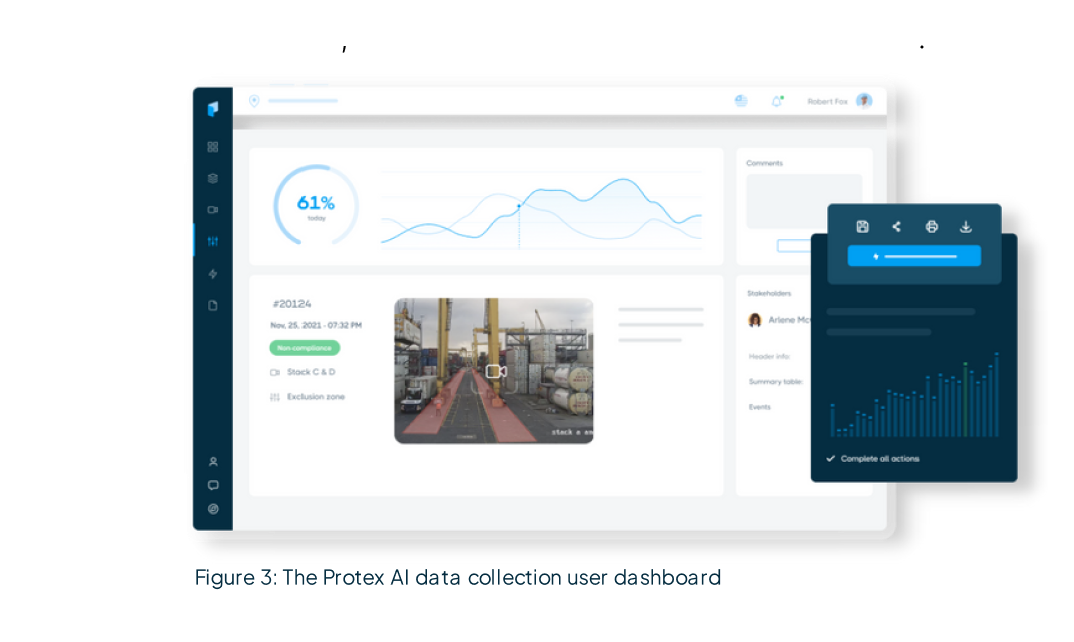
Increased processing power and advances in machine learning allows AI to recognise and identify objects in an image. AI vision has been shown to detect cancers in mammograms that doctors missed, and AI in passport application systems can detect in seconds if a photograph breaches requirements. Computer vision can now detect the events that lead to accidents in the workplace, and highlight these so that an EHS professional can review and investigate.
Step 3: Learn about your audience
To get your AI project approved, find out who needs to be on your side. Your organisational charts will show the formal chains for decision-making, but find out who influences the decision-makers. Your CEO is unlikely to approve an AI-based project without the support of department heads. Any implementation is likely to fail if you can’t bring workers and their representatives with you.
Your cost-benefit analysis (see Step 4) might help your case with the head of finance, but can you reassure the head of security that the CCTV images will be kept safely? Does the head of HR understand how people’s privacy will be protected? Will the Chief Technology Officer be concerned that the project will create extra work?
Remember too that senior managers have a lot of other targets to meet as well as goals of their own. Some might be looking for a high profile, high-tech project to back. Perhaps they want to be seen by clients to be keeping up with their competitors. Or there might be an industry award or conference spot in sight if an AI project is successful.

Step 4: Tailor your message
Craft your business case around the personal and professional goals of your audience, using their language. If you have the chance to present your case to the board, make sure you get across the key benefits they are looking for in the first few minutes. Focus on what you think they want to hear, but make sure you have the data and facts you need to answer questions. Take a similar approach with a written proposal – with the key selling points in a summary at the start, a description of how challenges will be overcome, and further data in well-structured appendices or tables.
Consider if photos or videos of the workplace could support your case. You could show a video as part of your presentation, or include a link in a written proposal.Sometimes decisions are made more informally. If you are going to have several one-to-one conversations with the key decision-makers, it is easier to craft your case for each one. Remember to speak to the influencers, as well as the final decision-makers.
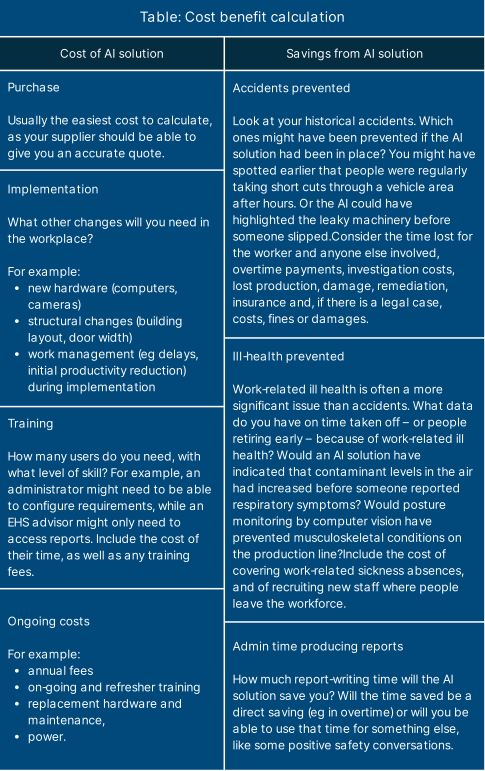
An essential element of your proposal will be a comparison of the costs and benefits. Table 2 identifies some of the items to include when working out the cost of a proposed AI solution. Be realistic – it won’t help your credibility to ask for a sum of money this year, and come back in 12 months’ time asking for an annual payment that wasn’t budgeted for.
Against this cost, estimate the benefits of the AI solution. Some organisations have excellent data which allows them to put a monetary value on each accident and ill-health report. If you can’t do that, a narrative comparison could be equally convincing. For example “this AI solution will cost us €xxxx in the first year, and €xxx each year thereafter, and for that I estimate we will avoid 3 major accidents, 10 minor accidents, and 20 cases of musculoskeletal disorders each year.”
Make sure you get the information you need from the AI provider about the barriers, such as data protection and cyber security. While some managers might be convinced by the numbers, others prefer a story, so ask the provider for some case studies of organisations like your own that have benefited from the technology and have overcome the challenges.
Step 5: Reinforce their response
You know that worker behaviour is influenced by reinforcement. Jack is praised for getting the job done quickly (even though he ignored some safety rules) while Jill is criticised for taking more time to follow a safe system of work. It is likely that Jill will eventually behave like Jack and accidents will occur.
Managers are no different. If you had their support for one project, give them some positive feedback about the results as soon as you can. If they don’t hear from you again until the next time you want resources they might be less receptive. Don’t overload them with feedback – they are too busy to read long and detailed reports. You might be able to provide them with a login to the new system to look at a personalised view of high-level results, or you can promise a monthly summary.A single good news story can be more effective than a year’s worth of data, especially if you mention the role of the senior manager in the story. For example, you might say:
“The computer vision system you supported last year has proved to be great at identifying leaks quickly. We’ve seen a reduction is slip accidents, and we detected the need for some maintenance that avoided an expensive breakdown.”
A second type of reinforcement was identified in a survey carried out by Protex AI in 2022. Nearly 400 people responded, representing multiple industries around the world. Those most confident that AI systems provide a benefit to EHS were the people from organisations which were already using other software systems for EHS. Where they had already tried out some AI tools in EHS, their confidence was further reinforced. If you can show your senior managers the benefits of an AI system in one area, they are more likely to support your next request.
Conclusion
There are now many proven ways in which AI can support the work of EHS. You need to be able to prove to your senior managers that its an investment worth making, over all the other options they have. Be realistic about the cost, time and effort needed to implement a new system, but balance these with the benefits to be gained. Understand who needs to be on your side, and what motivates them. Find a supplier who will partner with you to develop the business, and tailor it using the language and goals of your senior team.
Once you’ve had some success, celebrate this, giving credit to everyone who supported you.
Success breeds confidence, which breeds more success.
.webp)
.jpeg)
